56%
Bright. Persistent.
of digital sales lift comes from the creative.
Against 30% for the media.
Nielsen Catalina Solutions, Five Keys to Advertising Effectiveness (digital campaigns)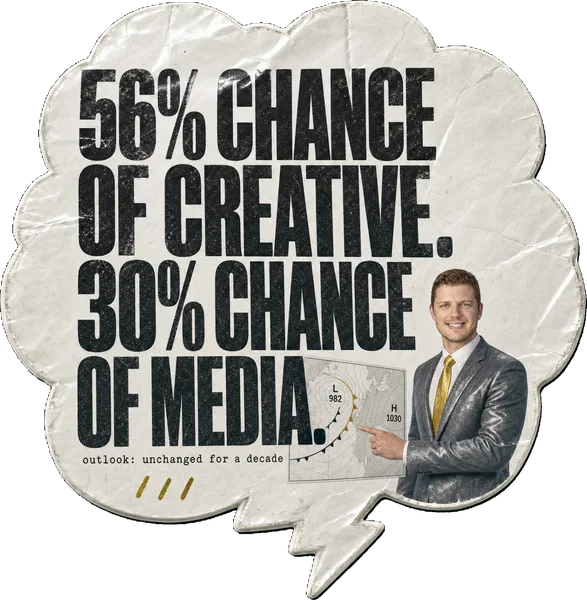
Alex Morris, Co-Founder, Vidsy · October 2026 · 4 min read


We invented a phrase that told everyone creative doesn't work, defended it for a decade, and then asked why the ads don't work.
The two wordsnon-working spend
"Non-working" was never a measurement. It was a filing decision.
01
A phrase we made up
For years, this was just how marketing budgets worked.
Media was "working spend." It was protected, optimized and treated as the part of the budget that actually drove the result, while creative was seen as a cost to reduce where possible.
Working spend
Media
Protected. The number the plan is built around.
Non-working spend
Creative
Scrutinized. Reduced where possible.
There was some logic to this.
When access to audiences, media buying expertise and scale created a significant competitive advantage, getting more budget into media could genuinely mean reaching more people and driving more growth.
But the market has changed.
And I think the language we use to describe these budgets is now badly out of date.
02
A machine that ate the rest
The creative forecast
Valid until the next planning cycle. Reissued every time somebody reforecasts.
56%
Bright. Persistent.
of digital sales lift comes from the creative.
Against 30% for the media.
Nielsen Catalina Solutions, Five Keys to Advertising Effectiveness (digital campaigns)up to 70%
Broad estimate. Still bright.
of advertising effectiveness depends on the creative.
A broad estimate, not a measured constant.
Create with Google
Look at what has happened to media buying over the past few years.
Targeting, bidding, placement and optimization are increasingly being handled by the platforms themselves. Meta, Google, TikTok and others are using increasingly sophisticated AI systems to work out who should see an ad, where they should see it and when.
That doesn't mean media has become unimportant.
It means one of the biggest remaining variables is what you actually put into the machine.
Six inputs. Every one of them stamped, initialed and filed under the column marked non-working.
These things generate the signals that the platforms then respond to.
Give the system strong creative and it has more opportunities to find an audience, learn and scale.
Beige. Approved. Scheduled. Repeat.

Give it ten versions of essentially the same mediocre ad and no amount of clever media optimization can manufacture a great result.
We see this all the time.
Two brands can spend roughly the same amount, on the same platform, against similar audiences, and get wildly different outcomes.
The difference is increasingly creative.
A brand might classify $10 million of media as working spend. But if that $10 million is repeatedly serving ineffective creative, how much of it is actually working?
That is why I think the traditional definition has the relationship backwards.
Creative isn't simply a production cost sitting in front of the "real" investment in media. It determines how productive that media investment can be.
If spending another $1 on creative can improve the return on the next $10, $20 or $50 of media, calling that dollar "non-working" makes very little sense.
Exhibit

03
A bill that came due
The answer isn't simply "spend more on creative." Plenty of money gets wasted on creative too.
The shift is to start treating creative as an investment that should be managed against performance.
That means three things.
The question shouldn't just be: what did this asset cost us? It should be: what did this creative allow the wider media investment to achieve?
One produces the signals. The other scales them. Creative strategy without performance data is guesswork. Media strategy without enough creative diversity eventually runs out of things to optimize. They need to operate as one system.

Understand what is working. Understand why. Turn those insights into hypotheses. Make the next wave of creative against them. Then repeat. That sounds obvious. In practice, very few large advertisers have built the operating model to do it consistently.

The distinction between working and non-working spend was useful for a different era of advertising.
But when creative directly affects the efficiency of millions of dollars of media investment, continuing to treat it as overhead misses the point.
Creative doesn't sit outside working spend anymore.
Creative is working spend.
Delete the line item