Rosie Arrowsmith, Client Director, Vidsy · July 2026 · 6 min read
The machine has read everything and met nobody
It knows every ad ever made and has never once been the person watching one, half asleep, sound off, looking for a reason to stop. We keep handing it the brief anyway.
The quiet plansynthetic by default, human where the budget allows
It has read every ad ever made. It has never been the person watching one.
01
The panel was unanimous
The debate moved on without the doomers.
Nobody on stage at Cannes in 2026 asked whether you will use AI.
That argument finished quietly some time last year, and both of the loud positions lost it. The people who said AI would replace creative teams were wrong. So were the people who said they would never touch it.
The settled question
Will you use AI?
Answered. Everyone does, including several people who told me they don't.
The live question
How much is acceptable?
Open. And it gets answered by your audience, not by your roadmap.
Augmentation is genuinely powerful. I have watched a localization job that used to take a week come back the same afternoon.
But the moment brand trust or the creative itself gets traded for a generative shortcut, audiences notice. They do not forgive quickly.
AI isn't replacing creativity, it's scaling it. The big ideas still matter. You still need people at the heart of that.
Advertising Week's wrap of the week said the quiet part out loud. The industry has stopped debating whether AI transforms marketing and started on the harder job of wiring it into everyday operations.
That is progress. It is also exactly where the expensive mistakes are about to get made.
02
The audience was not
Audiences don't punish the pixels. They punish the shortcut.
There is a story the research people keep telling at these things, and it complicates the easy version of this argument.
A large festive campaign ran using generative production. The reaction online was brutal. People said it looked cheap, felt hollow and missed everything the brand usually got right at that time of year.
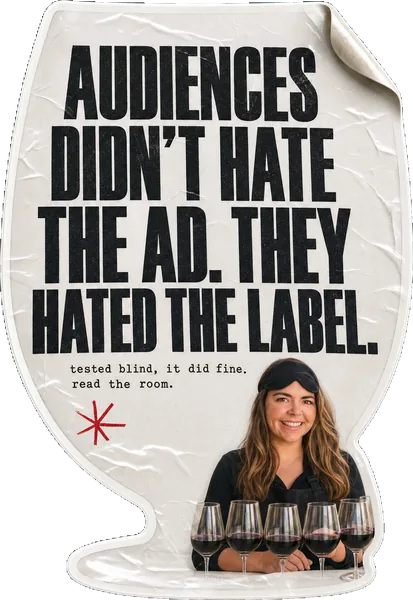
Then it was tested properly, blind, against the same measures every other ad gets held to. It performed. The viewers who had not been told how it was made could not find the flaw everyone else was so certain about.
A blind test, run on you
One of these was made with generative production. Pick it.
Counted in this browser session only. Nothing is sent anywhere, and closing the tab clears it.
What the internet said
It looked cheap and hollow. You could tell instantly.
What the blind testing found
It performed. The thing people could tell was the label, not the work.
So the penalty is not really about quality. It arrives with the disclosure.
That should worry you more, not less. A quality problem you fix in the edit. A trust problem sits on the brand.
What people are actually reading off the work is motivation. Why does this exist. Was it made because it was the best idea anyone had, or because it was the cheapest route to a deliverable by Friday.
People are extremely good at spotting an ad that was made to be made.
03
The order got reversed
Human first. Augmented second. Generative last.
Three tiers, and the sequence is the argument.
Read the order. Then drag it the other way.
Real kitchens. Real hands. Real accents.
Slide towards generative first to see what the order costs. It springs back.
Creator footage 01
Human
Real creators make the thing. Real kitchens, real hands, real accents. Every other tier depends on this one, because it is where the original material comes from.
The shoot The product placed in afterwards 02
Augmented
The idea and the performance stay human, and AI extends where the footage can go. One shoot carried into three languages. A product placed into a scene after the shoot with the light and the shadows matched. A vertical frame rebuilt for a 16:9 screen instead of cropped down to fit it.
AI generated
Fully synthetic 03
Generative
Fully synthetic, for the briefs where it honestly makes sense. Labeled every single time. And where a real person's likeness is anywhere near it, with their consent and their protection written into the agreement before anything renders.
Nothing here is destroyed and nothing needs undoing. Let go of the handle and the order comes back.
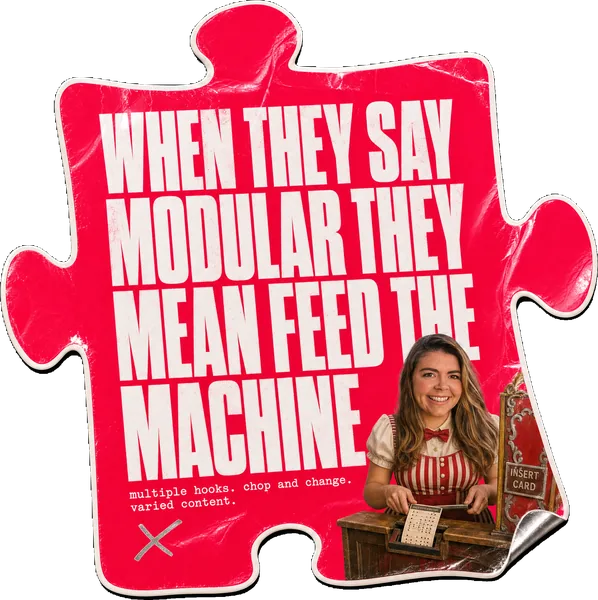
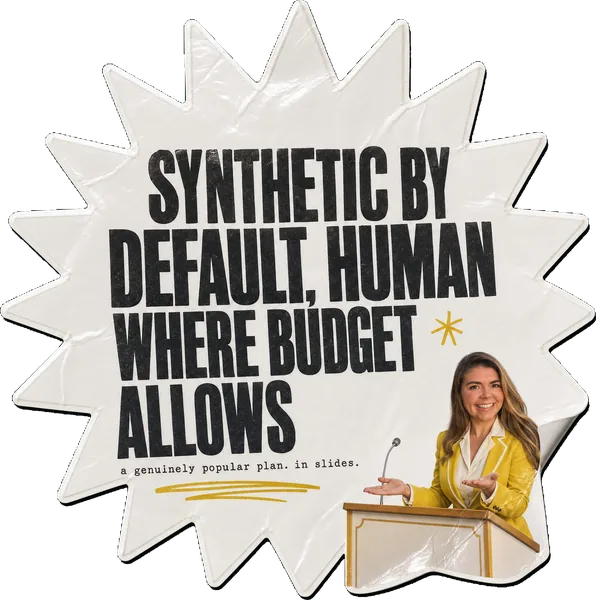
Run that list backwards and you get the operating model everyone is quietly worried about: synthetic by default, human where the budget allows.
I have not seen that produce good work. I have seen it produce a great deal of work.
A brief with nothing wrong with it
Brief
15 second social video, female 25 to 44, upbeat, show the product in the first three seconds, end on the logo.
What the brief got wrong
This field is not on the form.
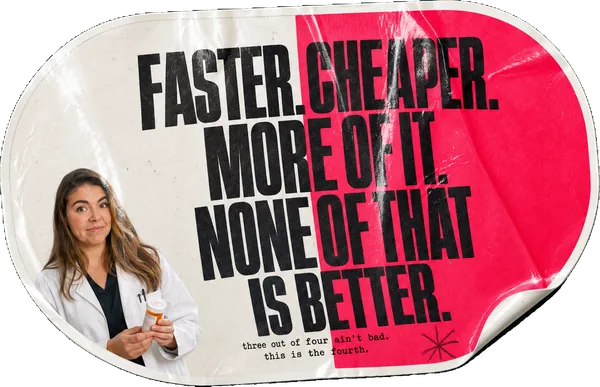
Four results
Same brief. Same four answers. That is the point.v01
Faster.
v02
Cheaper.
v03
More of it.
v04
Indistinguishable from the last one.
Real work. Nothing on this page was generated.
Look again at what tier two actually is. Every example is multiplication. A human made the ad once, and the machine carried it further than a person could have carried it in the time available.
That is a real gain and I would not hand it back.
Not one of those examples invented the ad.
04
Somebody still has to imagine it
The machine has read everything and met nobody.
Here is the part that has not moved through three years of all this.
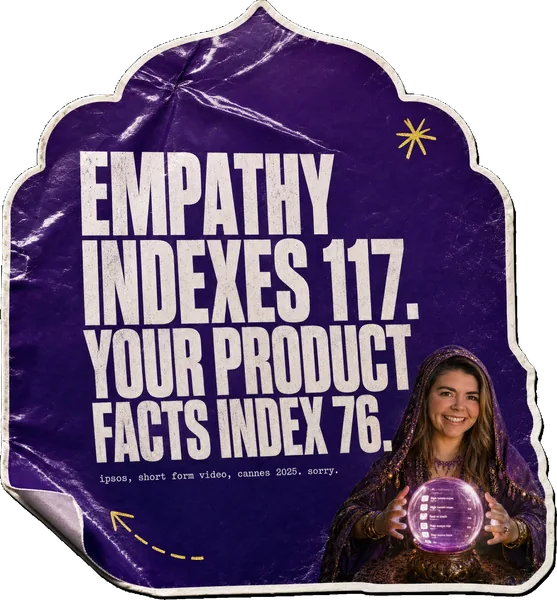
Ipsos has been testing ads against memory encoding for years, and the short-form panel it presented at Cannes in 2025 is the one the numbers below come from. What carries a short video is empathy and creative experience, well ahead of how much information you manage to fit in it.
117
index for empathy and fitting in, in short form video.
Creative experiences 107. Creative ideas 76.
Ipsos, indexed percentage increase in average memory encoding for ads rated high against low on each experience, presented at Cannes Lions 2025
+20%
ad effectiveness from combining creativity with empathy.
What Ipsos calls the MISFITS framework.
Ipsos Global Ad Testing meta-analysis, n=1,734 cases, presented at Cannes Lions 2025
+13%
memory encoding for creator ads over ads that don't use the tactic.
Measured on TikTok video ads.
Ipsos Creative|Spark Digital, n=289 cases
All three were shown on the Ipsos short form video panel at Cannes Lions 2025.
Empathy is the one to sit with.
It is not a tone or a style. It is knowing what it feels like to be the person this ad is aimed at, on a Tuesday, three seconds into a scroll, sound off, half looking for a reason to stop.
A model can describe that beautifully. It has read every description ever written. It has never been that person.
AI is trained on the past. Human creativity imagines the future. One learns from patterns and data. The other creates ideas, culture and the unexpected.
Which is why the strategy table is the seat I would not give up.
Give a model a thin brief and it will execute the thin brief. Beautifully, at volume, in nine languages, by Thursday. It will not stop and tell you the brief is thin.
A good strategist does, usually at an inconvenient moment, usually while everyone else is trying to get to a decision and go home.
That friction is the product.
So put the machines on orchestration, where they are extraordinary. Keep the imagining with the people who have actually lived in the world the ad is about.
AI earned a seat at the production table.
It has not earned a seat at the strategy table.
Don't give it one.
Read it before your next AI roadmap